
Inside the Foundry: A Snapshot of the Process From Conception to Completion
If you source aluminum parts, you already know that finding a reliable casting partner matters just as much as finding the right material. But do you know what actually happens from the moment your design file arrives to the moment your finished part ships? Understanding the aluminum casting process from start to finish gives you the tools to ask better questions, set realistic expectations, and build a stronger working relationship with your foundry.
At Boose Aluminum Foundry, we have been running the aluminum sand casting process since 1933 in Stevens, PA. The foundry casting process is more layered than most people realize, and walking you through it is one of the best ways we know to earn your confidence before you ever place an order.
Step 1: Aluminum Casting Design
Every successful part starts with a solid design. Aluminum casting design is where the most critical decisions get made, and it is also where the most costly mistakes can be caught early.
When you bring us a part, our engineering team reviews it for manufacturability using SolidWorks software. We look at wall thickness, draft angles, parting line placement, and any features that could lead to porosity or dimensional issues during production. This review process is called Design for Manufacturability, or DFM.
Good DFM guidance means fewer surprises in production, less scrap, and parts that meet spec consistently from the very first run. If your design is still in development, we are happy to work with you at that stage. Our on-site pattern shop can also help create or adapt tooling to match your project needs, so you are not starting from scratch every time.
Step 2: Choosing the Right Casting Method
Once your design is ready, the next decision is which process fits your part. Understanding your casting method options will help you match the right approach to your timeline, volume, and complexity requirements.
You may have heard of die casting or permanent mold casting as options in the aluminum world. Those processes work well in certain situations, but they are not what we do at Boose. Our capabilities center on sand casting, specifically green sand molding and no-bake molding. These two methods give us the range to handle the widest variety of parts, from repeatable mid-to-high volume production runs to larger and more complex metal castings.
Green sand molding is well-suited for parts up to around 20 lbs. Our Hunter automated molding machine runs this process with high repeatability, which means consistent results and better cost control for your production program.
No-bake molding uses a chemically bonded sand that cures at room temperature. It handles parts from 50 lbs up to 2,000 lbs. with few restrictions on size. This is the right choice when your part geometry demands more detail or when your casting falls outside the size range of the green sand line.
Step 3: The Sand Casting Process Step by Step
Here is how the aluminum foundry process unfolds once your design is approved and tooling is confirmed.
Pattern and Tooling
A pattern is built to match the shape of your finished part. If you already have existing plates or tooling, we can often adapt them to our sand casting process without starting from scratch, saving you time and upfront cost.
Mold Preparation
Sand is packed around the pattern to form the mold cavity. The precision of this step directly affects dimensional accuracy, which is why process control at the mold stage is so important to the consistency of every part we ship.
Gating System Setup
This step is easy to overlook, but it has a direct impact on part quality. The gating system controls how molten aluminum flows into the mold. A well-designed gate reduces turbulence, limits porosity, and supports pressure integrity in the finished casting. Poor gating is one of the most common causes of defects in the casting process.
Pouring and Solidification
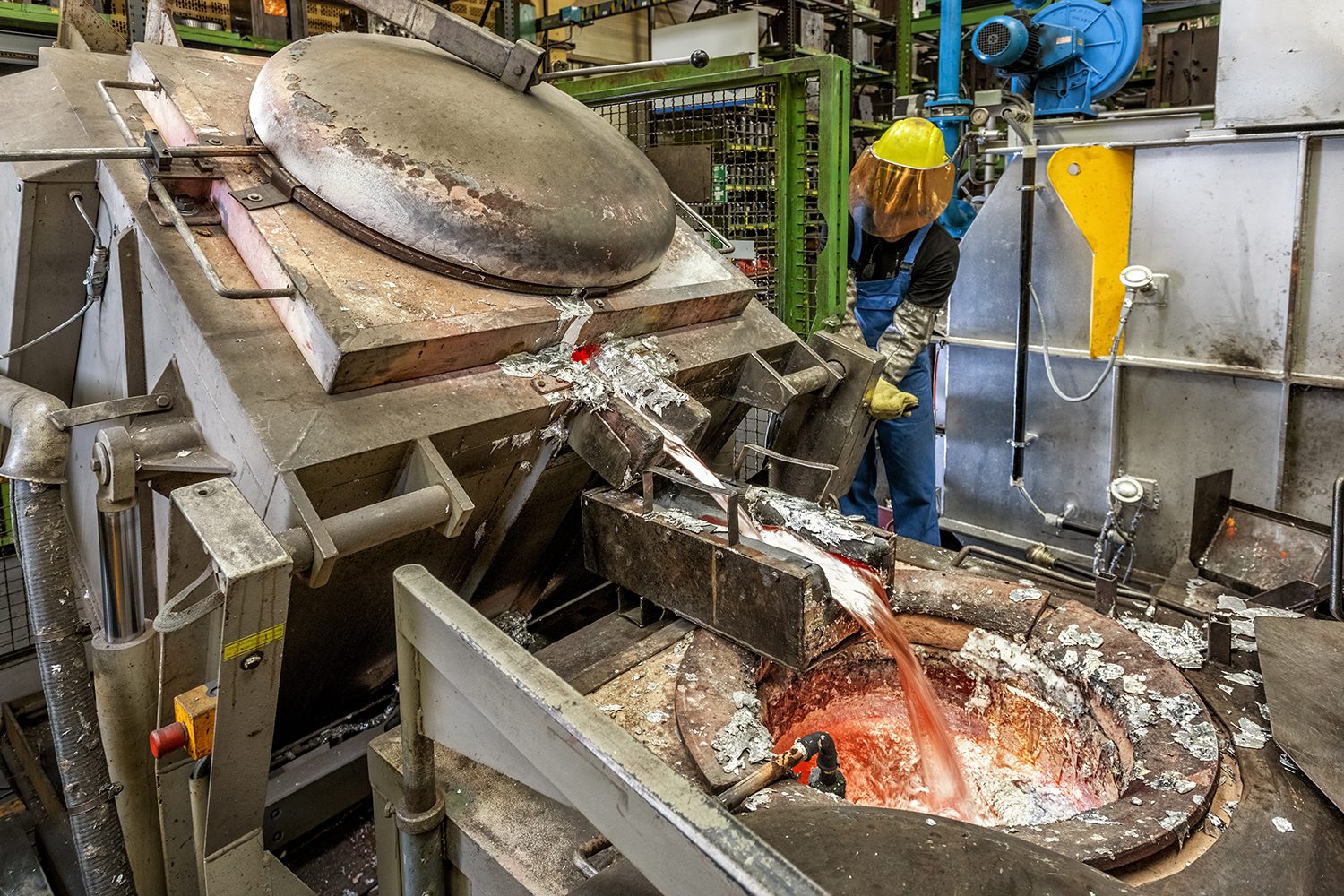
Once the mold is ready, we pour molten aluminum using quality aluminum alloys matched to your performance requirements. Whether your part needs to handle thermal cycling, resist corrosion, or maintain dimensional stability under cyclic load, alloy selection plays a key role in meeting those specs.
Cooling, Shakeout, and Sand Reclamation
After the metal solidifies, the sand mold is broken away, and the casting is removed. At Boose, we use thermally reclaimed sand, which cycles back into the molding process rather than going to waste. We also recycle scrap aluminum generated during production and look for opportunities to reduce energy use across our operations. Keeping our environmental footprint small is something our team takes seriously, not just as a practice but as part of how we run a responsible foundry.
Finishing and Inspection
Castings are cleaned, straightened as needed, and inspected before they leave our facility. Depending on your requirements, inspection can include dimensional checks, radiography (film and digital), liquid dye penetrant testing, and leak testing for pressure-sensitive applications like pump housings, valve bodies, and hydraulic manifolds.
Why Aluminum, and What It’s Right For
Aluminum is not the right answer for every application. Where it excels is where weight, corrosion resistance, design flexibility, and thermal performance all matter at once. That is why OEMs across medical equipment, defense, robotics, transportation, and industrial manufacturing rely on aluminum sand casting for parts like:
- Pump housings and valve bodies
- Hydraulic manifolds and reservoir housings
- Battery enclosures and control unit housings
- Sensor housings and electrical enclosures
- Engine covers, oil pans, and transmission housings
- HVAC housings and steering column components
Industries are moving quickly toward electrification, emissions-driven lightweighting, and more electronics-integrated platforms. Battery enclosures for electric equipment, lightweight hydraulic manifolds, and modular component housings are all areas where demand for quality aluminum castings is growing. If your product roadmap includes any of these directions, sand casting in aluminum deserves a close look.
Ready to Start Your Next Casting Project?
Now you have a clear picture of the aluminum casting process, from the first design review to final inspection. Good design reduces problems. The right process keeps costs under control. Consistent inspection means you can trust what you receive.
We have been doing this since 1933, and we still take the same approach on every project: responsive communication, competitive pricing, and quality you can count on. Whatever industry you are in, we want to hear from you.